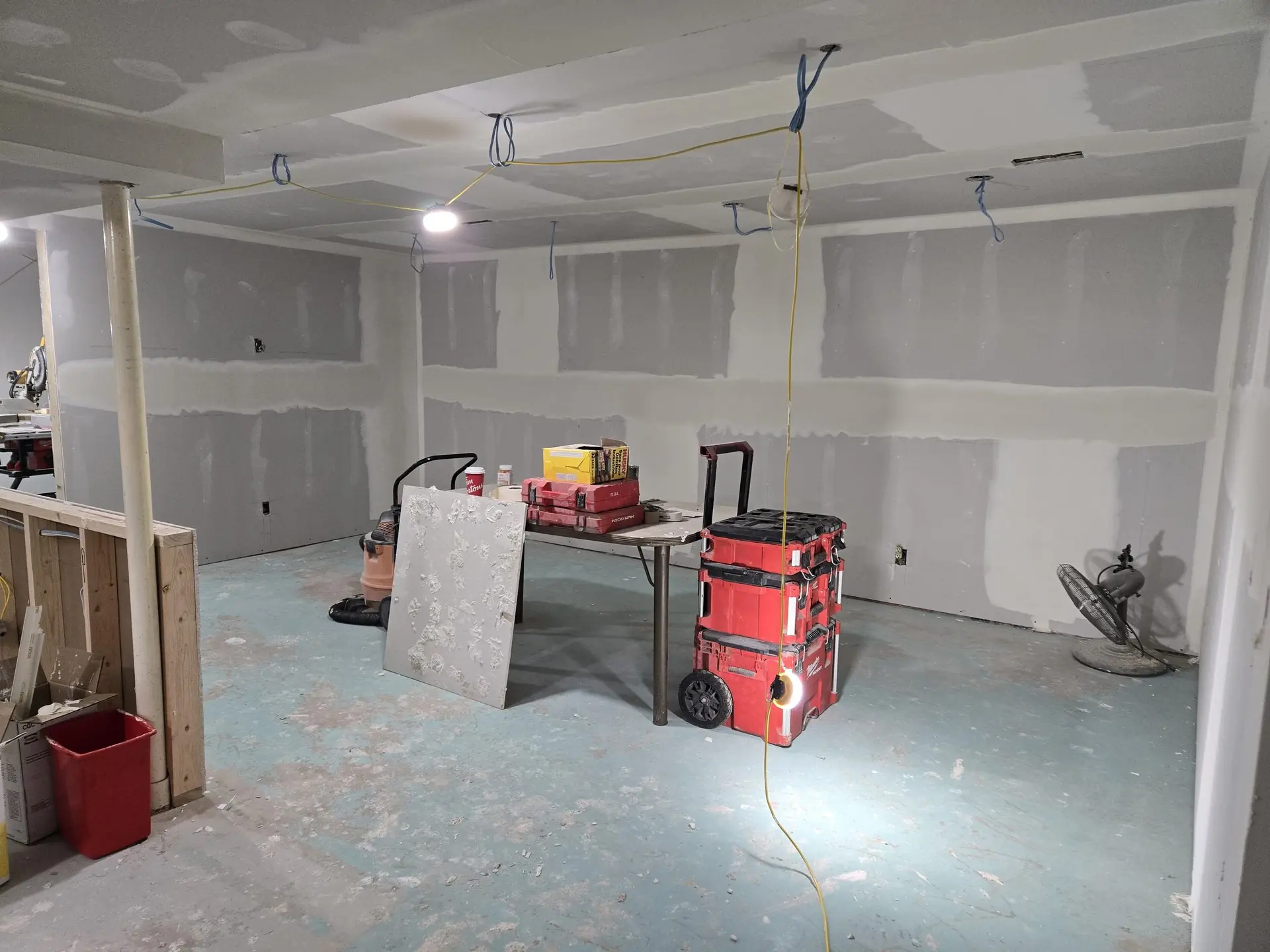
Drywall is the last trade that touches almost every surface you look at, and the first one people blame when a wall doesn’t look right. If you are planning work on a house here, the practical questions are usually the same: what board goes where, how good a finish do you actually need, what makes one quote twice another, and who is responsible when the paint goes on and a seam shows. This guide walks through drywall Calgary homeowners actually deal with, in the order the work happens.
Table of Contents
Two things make drywall here different from drywall anywhere else. Chinooks can swing the temperature more than twenty degrees in an afternoon, which moves framing and opens joints that were closed the week before. And a large share of the housing stock was built in two fast waves — the late-seventies boom and the 2000s expansion — so a lot of homes are now at the age where settlement cracking and original taping start showing their limits at the same time.
What Drywall Work in Calgary Actually Involves
“Drywall” covers at least four different jobs that get quoted as if they were one. Boarding is hanging the sheets. Taping and mudding is filling the joints and building the flat surface. Texture is what goes on top, if anything. Painting is a separate trade that inherits every mistake made by the three before it.
Most homeowner frustration comes from that last point. A wall that looks fine under work lights can show every seam once it is painted and a window puts raking light across it. The finish was always like that — the paint just made it visible. That is why the finish level you agree to matters more than almost anything else in the quote, and why it should be written down rather than assumed.
A repair job has the opposite problem. Patching a hole is quick. Making the patch disappear into the surrounding texture is the actual skill, and it is the part that separates a crew that does drywall from a crew that does drywall well. If you are trying to work out which one you are talking to, How to Choose a Drywall Contractor in Calgary Without Guessing covers the questions that surface the difference early.
asset:image/drywall-services-04
Site set up for drywall services in Calgary
Board, Prep and the Order the Work Happens In
Not all board is the same, and using the wrong sheet in the wrong room is one of the few drywall mistakes that is genuinely expensive to undo later.
- Standard board handles most interior walls and ceilings in a dry, heated house.
- Moisture-resistant board belongs anywhere humidity is routine — bathrooms, laundry rooms, and the wet side of a basement build.
- Type X fire-rated board is required where fire separation is part of the assembly: attached garages, mechanical rooms, and the separations in a legal suite.
- Sag-resistant ceiling board exists because ceilings carry their own weight differently than walls do, especially at wider joist spacing.
The differences run deeper than thickness, and if you want the underlying material science rather than the job-site version, Wikipedia’s drywall entry is a reasonable neutral starting point. For what each type means on an actual Calgary job, Gypsum Board Types Explained for Calgary Homes goes room by room.
The order almost never changes: framing and rough-ins get inspected, insulation and vapour barrier go in, board goes up, joints get taped and coated in stages with drying time between them, the surface gets sanded, then texture if any, then paint. Each coat has to dry before the next one goes on. That drying time is not padding in the schedule — it is the schedule. Drywall Timelines in Calgary: How Long Each Stage Takes breaks down where the days actually go.
Winter compresses some of that and stretches other parts of it. Dry indoor air pulls moisture out of compound faster, which sounds like an advantage and often is not — mud that skins over before it cures underneath will crack or shrink back at the joint. Winter Drywall Work in Calgary: What Cold, Dry Air Changes covers what a competent crew does differently between November and March.
asset:video/1-drywall-services
Walkthrough: what the taping and finishing stages actually look like on site
asset:image/drywall-services-05
Hands-on drywall services detail, Calgary
What Drives the Cost
There is no honest flat rate for drywall, and any quote that arrives as a single number per square foot without anyone seeing the space is a number that will move later. What actually drives it:
- Finish level. The difference between a standard wall finish and a high-end one is several additional coats and a great deal more sanding across the whole surface. It is one of the largest single variables in any quote.
- Ceiling height and access. Anything above a standard reach means staging, slower work and more handling. A stairwell or a vaulted ceiling costs more than the same square footage on a flat main floor.
- Repair versus new work. New board over open framing is predictable. Repairs are not — the scope is whatever is behind the wall, and nobody knows that until it is open.
- Texture matching. Matching an existing texture across a patch is slow, skilled work, and it is the difference between a repair you can see and one you cannot.
- Board type. Fire-rated and moisture-resistant sheets cost more and are heavier to handle.
- Site condition. An empty room is faster than a furnished one. Occupied houses need protection, containment and cleanup that an empty new build does not.
This is also why scope wording matters. “Drywall the basement” can mean board only, or board through to a paint-ready finish, and the gap between those two readings is most of the disagreements that happen at the end of a job.
Doing It Yourself vs Calling a Pro
Some drywall work is genuinely reasonable to take on. A single small hole in a low-traffic wall, in a room with a flat painted finish and no texture to match, is a fair weekend job. The materials are inexpensive and the failure mode is cosmetic.
The jobs that go wrong for homeowners are the ones where the difficulty is invisible until you are committed: anything on a ceiling, anything that needs texture matched, anything across a large uninterrupted surface where flatness shows, and anything involving fire-rated assemblies where the requirement is not aesthetic at all. Sanding is also a genuinely unpleasant, dust-heavy job that most people only underestimate once.
Structural and permitted work sits in a different category again — that is not a skill question, it is a compliance one. Do You Need a Permit for Drywall Work in Calgary? covers where the line falls.
Older homes deserve their own warning. If a house predates drywall’s general adoption, what is behind the paint may be lath and plaster, possibly patched with drywall by a previous owner. The two materials do not behave the same way and cannot be repaired the same way. Drywall vs Plaster in Older Calgary Homes: How to Tell explains how to identify which you have before you open anything up.
One Crew for Drywall and Paint
Drywall and paint are usually sold as two trades, and the seam between them is where accountability tends to disappear. When a finished wall shows a flaw, the painter says the surface was not flat and the drywaller says the paint or the lighting exposed it. Both can be partly right, and the homeowner is left arbitrating a dispute they have no way to judge.
Running both under one crew removes the argument, because the same people who built the surface are the ones putting the finish coat on it. It also changes the sequencing — a crew that knows it is painting the wall itself has a direct reason to get the surface right the first time rather than passing it along. Our full range of drywall services is organised around that, from boarding through to the final coat.
asset:image/drywall-services-06
Drywall Services once finished in Calgary
Quick Answers
What finish level do most Calgary homes actually need? Most walls in a typical home are finished to a standard level that looks correct under normal lighting. The higher levels earn their cost in specific places — large uninterrupted walls, rooms with big windows throwing raking light, and gloss or near-gloss paint, all of which expose imperfections that flatter finishes hide.
Can an existing texture be matched on a repair? Usually, yes. Texture matching is a separate skill from taping and finishing, and it is what decides whether a repair reads as invisible or obvious. It is worth asking specifically whether a quote includes matching, because it is not automatic.
Why do new cracks keep appearing after the work was done properly? New framing dries and settles through its first couple of heating seasons, and the Chinook cycle moves it more than a steadier climate would. Hairline cracking at joints during that period is often the house moving rather than the drywall failing. Cracks that widen, run diagonally from corners, or reopen repeatedly after repair are worth having looked at.
Keep Reading
Every link below is a page or guide this article draws on, listed in full rather than buried in the text.
- GuideHow to Choose a Drywall Contractor in Calgary Without Guessing
- GuideDrywall Timelines in Calgary: How Long Each Stage Takes
- GuideWinter Drywall Work in Calgary: What Cold, Dry Air Changes
- GuideGypsum Board Types Explained for Calgary Homes
- GuideDo You Need a Permit for Drywall Work in Calgary?
- GuideDrywall vs Plaster in Older Calgary Homes: How to Tell
- ServiceDrywall Calgary
- ServiceAll Drywall Services
- ReferenceDrywall — Wikipedia
Summary
Drywall Calgary work comes down to four decisions: the right board for the room, a finish level that is written down rather than assumed, a scope that says clearly where the drywaller’s responsibility ends and the painter’s begins, and a crew that will tell you what is behind the wall before quoting a repair. Get those right and the rest of the job is schedule and dust. Emplastrum Drywall is a licensed Calgary drywall contractor (BL288604) working across Calgary, Airdrie, Cochrane, Chestermere and Okotoks — if you want a quote on drywall Calgary homeowners can compare properly, the fastest route is to tell us what the space looks like.
Need a Drywall Quote?
Free, no-obligation quotes for NW Calgary and Cochrane homeowners. Tell us about your project.
Get a Free Quote